
With winter coming, so is the question of closing the pool.
With Vigipool and its smart control units, active winterisation is made simple thanks to a temperature sensor and a built-in frost protection mode that automates the filtration system according to your chosen settings.
Active or passive winterising: what’s the difference?
Passive winterising involves draining part of the pool and shutting it down to protect the pipes and equipment from freezing. It is particularly suitable for regions where sub-zero temperatures are frequent and prolonged.
Active winterising, on the other hand, involves keeping the filtration system running at an appropriate level throughout the winter. The water continues to circulate, which helps to minimise the risk of freezing in the plumbing system when conditions allow.
This method allows you to retain the pool water and maintain continuity in maintenance. However, it requires monitoring appropriate to the climate and is not suitable for all situations: in the event of prolonged freezing, additional protective measures may be necessary.
Tild and Vigipool: active winterisation that’s easier to manage
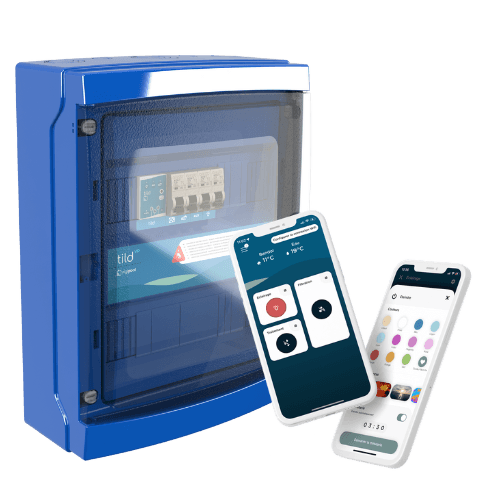
With the Tild smart control panel, CCEI makes it easier to manage the swimming pool during winter time, thanks to its temperature probe and two protection thresholds. In thermoregulated mode, as soon as the temperature reaches 15 °C, the Tild activates a 30-minute filtration cycle every 4 hours. If the temperature drops to 2 °C, the anti-freeze mode triggers continuous filtration to minimise the risks associated with freezing.
Winter mode also applies to our water treatment solutions. All salt chlorinators stop producing chlorine once the temperature reaches 15 °C. With Vigipool, compatible devices have a winter mode within the app, allowing you to adapt the settings for this period, especially for pH and level control.
A few precautions for winterising the equipment properly:
- pH and ORP sensors: it is recommended that you remove them from the pipework and store them in their suitable storage containers.
- Salt chlorinator cells: these must be removed from the pipework and stored in a dry place, or the bypass must be closed, depending on the system’s configuration and the manufacturer’s recommendations.
These settings and precautions enable you to adapt the equipment’s operation for winter and prepare more confidently for recommissioning in the spring.
Key points for effective winterisation:
- Adapt winterisation to the local climate
- Protect pipes against freezing
- Use automated solutions for added safety
- Plan ahead to make restarting in spring easier
With Vigipool, the swimming pool benefits from automated management, without the need to manually start the filtration system every time the temperature drops.
For professionals, this solution enables them to offer pool owners a connected, practical system designed to simplify maintenance throughout the year.
A well-managed active winterisation combined with smart solutions, is beneficial for the environment. It protects the installation, extends the lifespan of the equipment and saves water by avoiding the draining of the pool.
The key to getting through the winter with peace of mind and ensuring a straightforward return to service in the spring.